
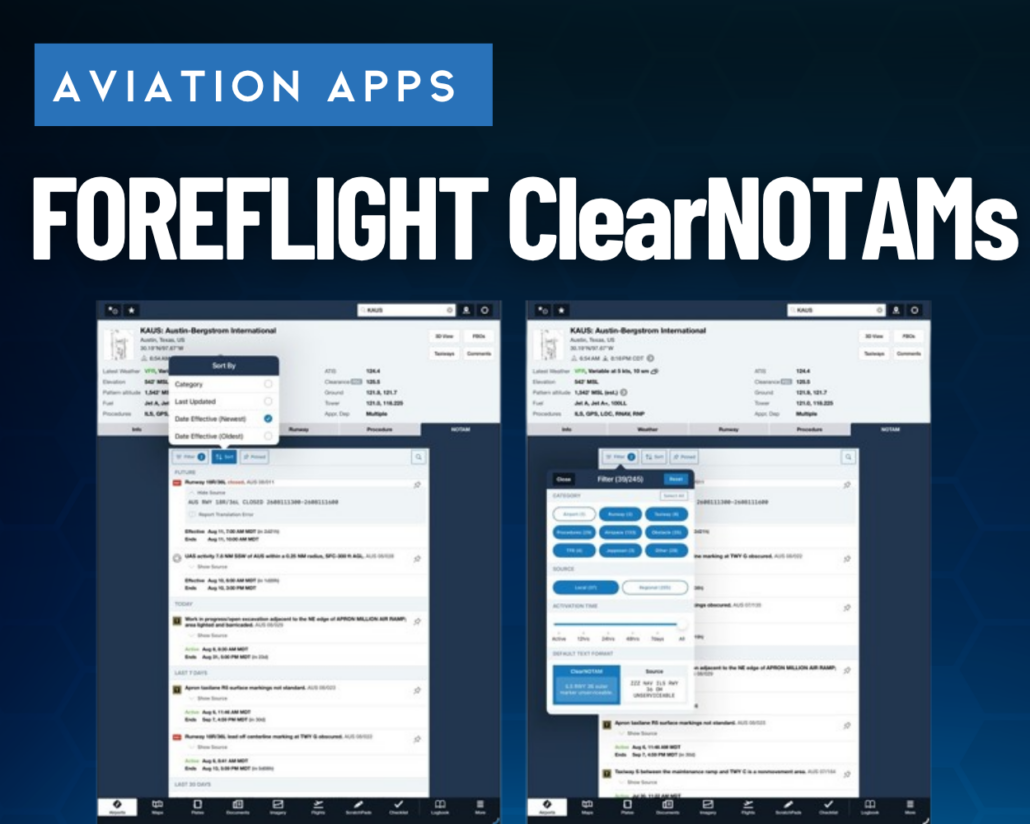
ForeFlight Introduces ClearNOTAMs: Plain-English, AI-Powered NOTAMs
If you have spent any time staring at screen full of ALL-CAPS, heavily abbreviated text trying to figure out if a runway is closed or if a crane is erected 2 miles off the departure end, you know the frustration. The traditional NOTAM format is an archaic leftover requiring pilots to spend far too much mental bandwidth deciphering information that should be instantly understandable.
Announced ahead of AirVenture 2026, ForeFlight is directly tackling this long-standing general aviation headache with ClearNOTAMs—a new feature leveraging AI to translate complex NOTAM coding into concise, plain-language summaries directly inside the app.
How ClearNOTAMs Works
Rather than replacing the official NOTAM text, ClearNOTAMs sits alongside it as a primary plain-English translation. ForeFlight trained specialized AI models on aviation terminology and built in automated cross-checks to ensure translations remain accurate without altering operational intent.
- Instant Translation: The default text shown across ForeFlight is rewritten in plain language focused on the actual operational impact.
- Tap for Raw Text: Tapping the summary instantly reveals the official, raw coded version so you can verify the details or check the authoritative source at any time.
- Deep Integration: ClearNOTAMs summaries appear everywhere you review NOTAMs—including Airport Info pages, Graphical NOTAM map layers, flight plan views, and the Graphical Preflight Briefing.
ClearNOTAMs in Action
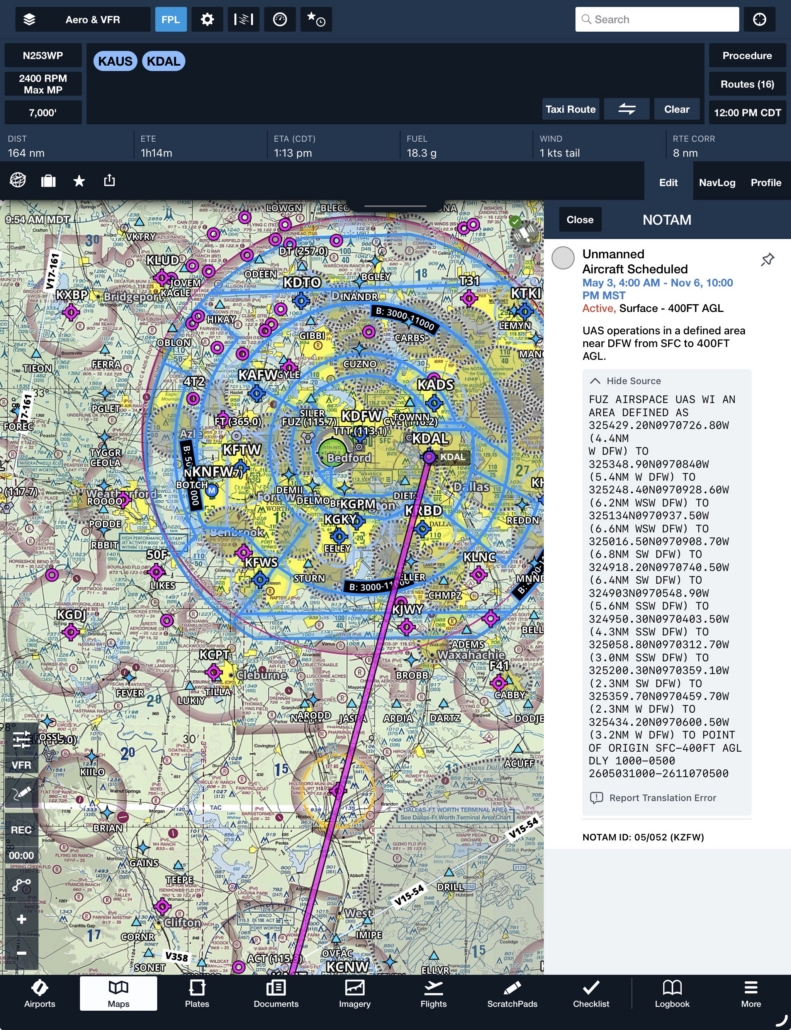
Let’s take a look at ClearNOTAMs on a flight from Austin-Bergstrom (KAUS) to Dallas Love (KDAL) in our Cessna Skylane.
Here’s the ForeFlight Route Map showing AUS-DAL with Graphical NOTAMs layer active and the plain English NOTAM for UAS activity displayed.
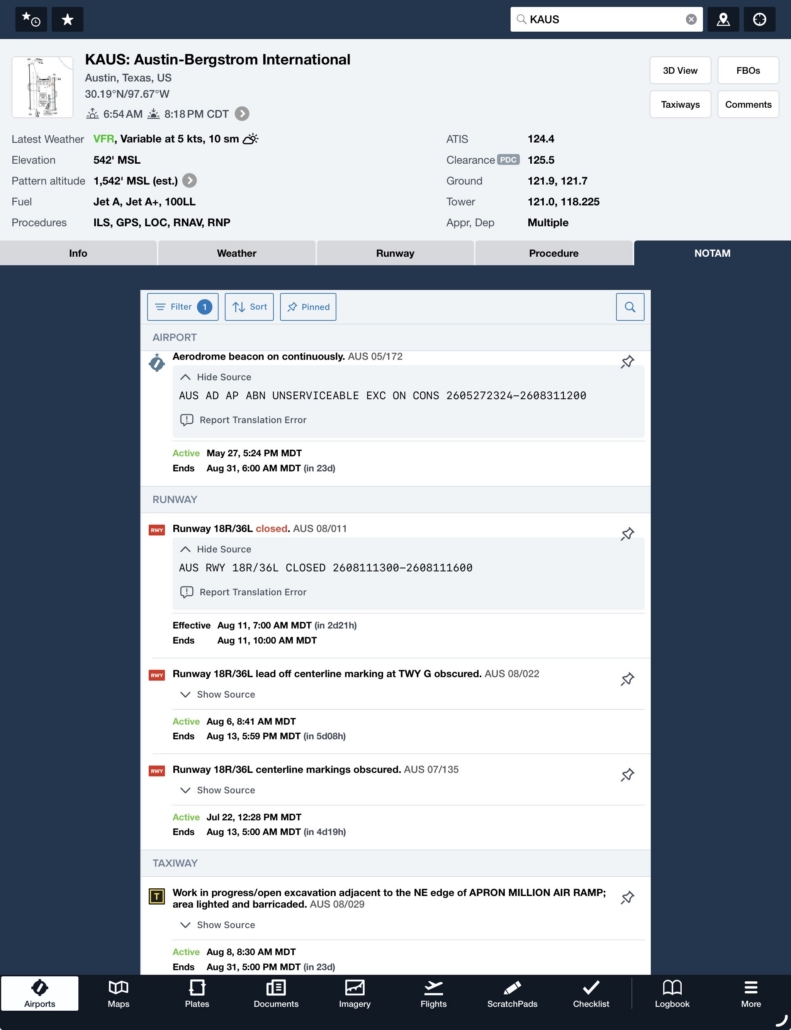
And here’s the side-by-side comparison of a raw NOTAM vs. the ClearNOTAMs summary at KAUS.
Major User Interface Upgrades to NOTAMs
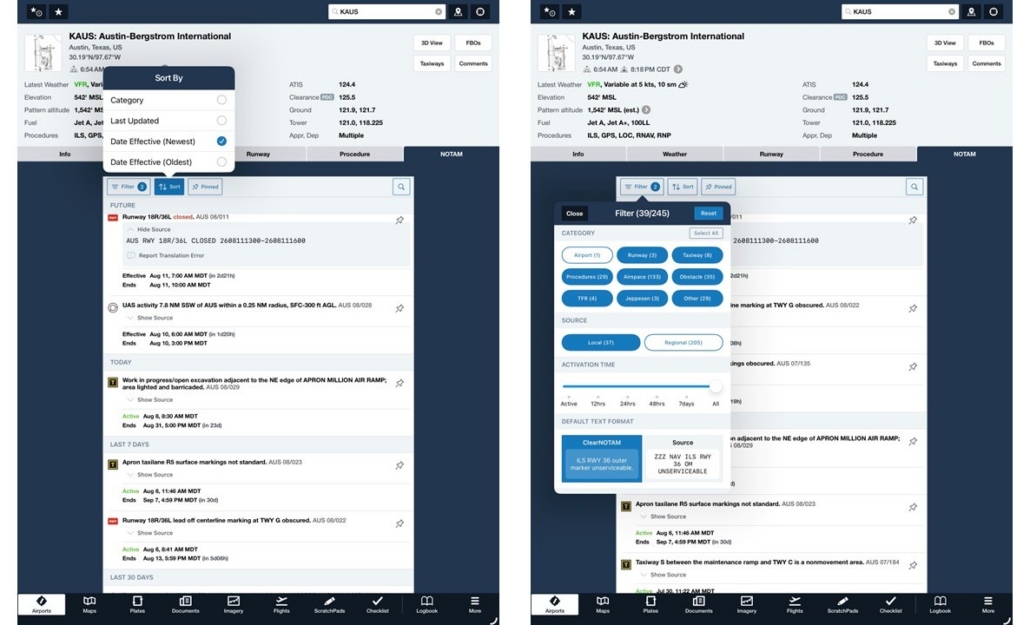
Beyond the AI translations, ForeFlight upgraded the core NOTAM interface across all subscription tiers, making it significantly easier to manage long lists of notices:
- Customizable Filtering: Filter notices by category (Runway, Airport, Airspace, Obstacle), issuing authority, or active time window.
- Sorting Options: Sort by category, last updated time, or effective time (ascending or descending).
- Pinning: Pin essential NOTAMs to the top of your list with a single tap so high-priority items never get buried.
- Collapsing: Double-tap minor or irrelevant NOTAMs to collapse them down to a single line without hiding them completely.
Pricing & Availability
ClearNOTAMs has launched as a complimentary three-month trial for all individual ForeFlight subscribers on mobile and web.
Following the trial period, ClearNOTAMs will require a Premium individual subscription (or Business Performance / MFB Performance plans).

- 5 Ways to Make Your iPad EFB Less of a Distraction - September 23, 2026
- The Sporty’s Pilot Training App Adds a New Garmin Autopilot Course - September 2, 2026
- New Flight Gear Backpack Built Around Starlink Mini - August 28, 2026


this is great news – NOTAMs have, for a long time, been confusing. I wonder what the liability path will be if (when) the AI provides an inaccurate interpretation – that leads to a pilot infraction?
This is great, but why do we need AI to do it. Why can the original NOTAM by written in plain language?
Why can’t pilots learn to read NOTAMS?
30 years of experience, instead of saying NOTAMs are “hard” I put in the effort to learn to read them.
It takes much longer to read and summarize METARs and NOTAMs in plain language than it does to read the abbreviations.
Because some of us are recreational pilots and don’t have your 30 years experience. To me it’s a safety issue. Would you also like to translate them from Spanish?
Another step in the dumbing down of aviation. 🙁
The FAA needs to do this and has for years. The abbreviations probably date back to when paper was limited or expensive.
Why should we have to pay ForeFlight to fix a safety issue that the FAA has created?
I remember the days of teletype when each character was fairly “expensive.” That situation is greatly reduced. I agree that I can read the raw METARs and TAFs quicker and more accurately than plain English but I read more of them per flight than I do NOTAMs.
What is really needed is notam consolidation in FF brief. Flying around DC SFRA and TFRs there are two different issues creating pages and pages of repeat notam listings. First is DC and NY center put out their own unique ID notams with exact same text for same TFR/notam, second is FF repeats/shows same notam for every location that that they link to that notam…for TFR or SFRA it is numbing.
Suggest that each unique event notam be listed only once, then show the multiple associations in parens or something similar, whether that duplication be due to FF’s associations or same text put out by multiple controlling agencies.
Big Caution. I have already experienced one AI translation error, and reported it to FF, which they acknowledged. The NOTAM regarded approach minimums and the alternate minimums were translated incorrectly when compared to the FAA site. It is not perfect yet (and will it ever be?), so for critical NOTAMS or if something just doesn’t look right (which is how I caught it), please double check against the FAA source.
It was a lot of work to learn the code but I did. However I never understood why the code was necessary. I get that it was easier for the teletype operator, fewer key strokes, but the teletype machines went away decades ago. There was no reason to wait this long.
AI can and will make mistakes. It is a huge safety issue when this happens. Pilots should NOT trust these AI interpretations. Requiring you to read the authorative source to be perfect legal.
Which makes this feature useless.
NOTAMs are relatively easy to read with some practice and all pilots should be able to do so.
Although I agree that nowadays NOTAMs should be written in normal text.