
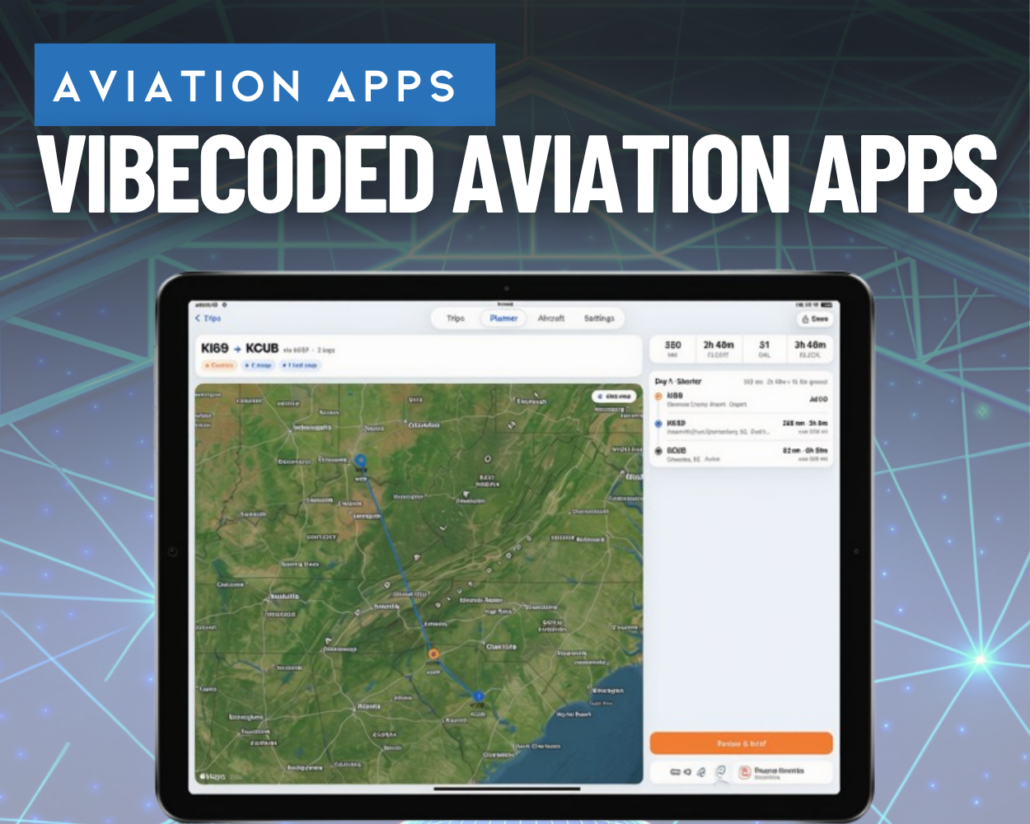
The rise of “vibecoded” aviation apps: how to experiment while staying safe
If it feels like the number of aviation apps has exploded in recent months, you’re not alone. After years of relative boredom on the iOS App Store, suddenly there are dozens of apps for checking weather, calculating a flight’s risk score, finding flight schools, or logging time. Many of these apps have a strikingly similar appearance, with some combination of dark backgrounds and bold colors. What’s going on?
Welcome to the new world of app development, where an individual pilot with an idea and some AI tools can compete with established engineering companies like Jeppesen ForeFlight and Garmin. The results are simultaneously exciting and worrying.
Why apps are easier to build now
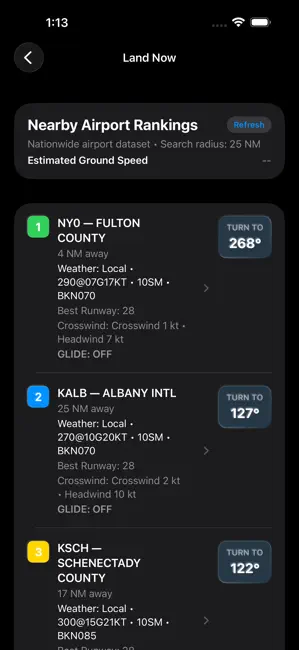 The driving force behind the huge growth in aviation apps is a new approach to software development, often called “vibecoding.” This phrase, which has modestly negative connotations in some circles, refers to a process that uses natural language conversations to dramatically reduce the time it takes to move from concept to functional app. Instead of spending years mastering Swift or Objective-C, you can just chat with Anthropic’s Claude Code or OpenAI’s Codex. The AI agent takes your concept, structures the database, builds the graphical interface, and packages the app for end users—with little or no code written by humans. It’s not quite as simple as explaining your idea to ChatGPT and getting a finished app, but it’s close. This represents a massive change for the software industry.
That change is obvious in both numbers and style:
- Numbers: Global App Store submissions, after being stable for years, nearly doubled in early 2026, right about the time AI coding tools took off. Apple has been scrambling to react, as their manual app review processes have been overwhelmed by the surge. There are simply a lot more apps than there were a year ago.
- Style: Most new apps have a “Claude look” that includes dark backgrounds, neon accents, techy-heavy fonts, and bordered card containers with rounded edges. Once you notice it, you’ll see the look everywhere. Vibecoded apps don’t have to look this way, but many do.
Good and bad changes
These changes are not necessarily bad. In some ways, it’s a return to the early days of the App Store, when pilots would eagerly search through an ever-changing list of new apps that promised to make their flying safer or easier. That level of innovation has been rare in recent years, as the options became fairly stale and smaller app developers either disappeared or were bought out. If vibecoding adds a little energy to the market, that’s a welcome change.
Having said that, history shows that quickly removing limitations can have unexpected consequences. The Internet and YouTube meant anyone could be a journalist or movie star overnight, which has been both good (inspiring flying videos from young content creators) and bad (outrageous “accident analysis” videos from unqualified crooks). While the options have increased dramatically, so has the standard deviation—the good content will get better and the bad content will get much worse. How can you tell the difference?
That’s the challenge for pilots in a world of vibecoded aviation apps: some will be exciting and creative solutions to previously unaddressed problems; some will be dangerously incomplete personal hobby projects. To state the obvious, this difference matters in aviation. It’s one thing if you download a puzzle game that isn’t reliable, but if your takeoff performance calculator is inaccurate it could cost you much more than the modest app subscription.
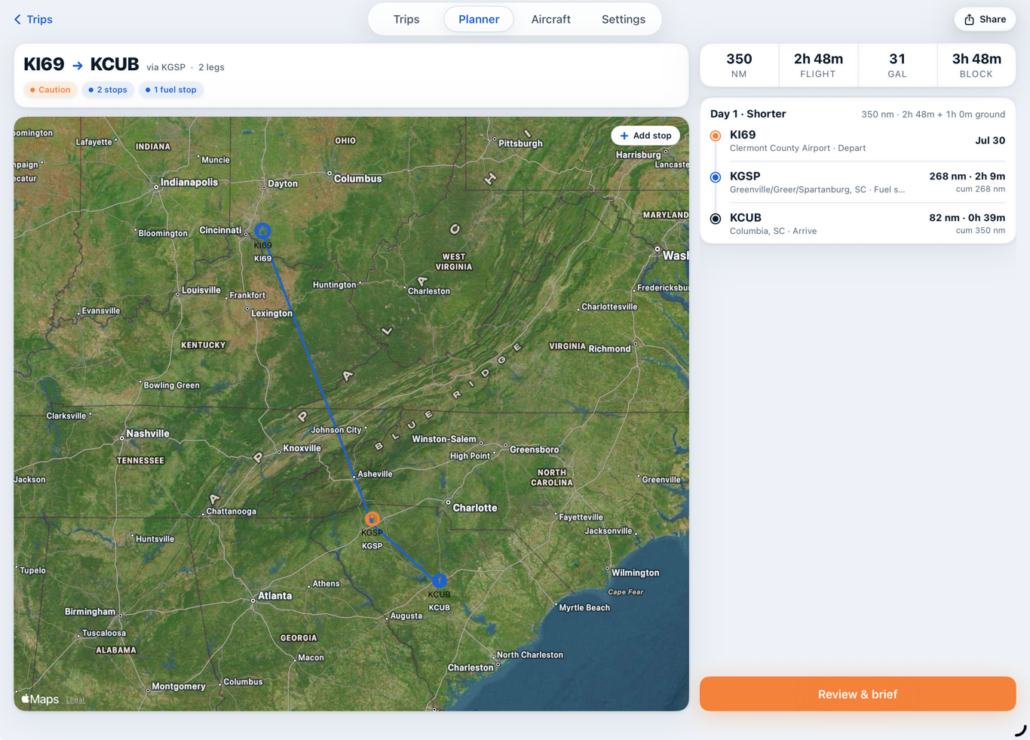
How to stay safe
Given those risks, here are a few rules for integrating new apps into your flying. Most of these were good habits before vibecoded apps appeared, but they take on extra importance when you don’t know which apps to trust:
A proof of concept isn’t a proven tool.
An app that works in a demonstration isn’t necessarily ready for the cockpit. Test its assumptions, look for edge cases, and verify its results before relying on it in flight.
- Test the app on the ground: The cockpit of a GA airplane is not the place to discover a critical bug or important limitation. Any new app should get a thorough test flight on the couch, where you have time to skeptically evaluate each feature. Don’t rush this step.
- Focus on edge cases: It has never been easier to build a proof of concept, but a POC does not equal a reliable app, and it’s the rarer scenarios that usually expose an app’s weaknesses. For example, I tested a handful of new weather or flight planning apps this summer, in preparation for flying to Oshkosh. Half of them showed forecasts for good VFR, even though thick wildfire smoke blanketed Wisconsin and scrambled arrivals. The problem? The app developers hadn’t thought to pull in smoke as a weather product, since it’s relatively rare. That’s a problem.
- Compare a new app to a reference: The way to detect these edge case failures is to check the output against a known source. In the case of the weather apps, it was easy to review forecasts and reports from ForeFlight, Garmin Pilot, or AviationWeather.gov. But it doesn’t have to be another app: check performance data against the POH or compare flight training advice with the FAR/AIM. You have to know what the right answer looks like to know if the new app is wrong.
Know what the right answer looks like.
Don’t make a new app its own source of truth. Compare its output with a trusted reference, such as your POH, official weather products, or an established aviation application.
- Verify data sources: Garbage in, garbage out is the first rule of software development, and it’s true whether you’re writing COBOL or chatting with Claude. Investigate the source of your app’s data by reading the documentation or even emailing the developer. Is the weather from the FAA or more experimental sources? Both might work, but it’s important to know the difference. Check how often data is updated (most airport and airspace data is updated on the 28-day AIRAC cycle). See how the app handles errors or incomplete data (does it fall back or just fail?).
- Have a backup plan: Again, this is great advice no matter the app. If that new app quits working (maybe because the developer loses interest, maybe because the server goes down), can you replace it with another app, printed document, or physical tool?
- Talk to the developer: Especially if your new app is mission-critical, it’s smart to do some investigation on the company (or person) behind it. Contact their support team to verify any details that are unclear, see how knowledgeable they are about the product, and get a general feel for the people who built the app.
Long established apps like ForeFlight and Garmin Pilot are not flawless, but they do have rigid testing and quality control processes in place to reduce errors and outages. If you’ve ever toured their facilities or talked to their teams at an airshow, it’s obvious they do not just roll out random updates or pull in data from any old source.
That’s also true for their use of new technology. Jeppesen ForeFlight recently released Airflow, a sophisticated AI platform for aviation which hints at some impressive features but also includes a number of guardrails. While some of the Airflow website is marketing, there are some good concepts to consider for any app, including verifying data integrity, keeping a human in the decision loop, and reviewing how a model made its decision.
Finally, consider the job your new app is doing. Some higher end features, like synthetic vision, performance planning, and flight plan filing should probably be left to established companies with a proven track record. For secondary tasks, like aviation event calendars, basic airport weather reports, or post-flight debriefing, a brand new app might fill a gap in your current app library.
“Trust, but verify” is cliched advice, but it’s a great way to approach most decisions in aviation. Apps are no exception.
Have you tried a vibecoded aviation app?
We’d like to hear about your experience. Share your thoughts in the comments.

- The rise of “vibecoded” aviation apps: how to experiment while staying safe - October 19, 2026
- Using an iPad for flying: how old is too old? - October 8, 2026
- Garmin introduces D2 Mach 2 Pro smartwatch with LTE, Iridium - April 24, 2026

Leave a Reply
Want to join the discussion?Feel free to contribute!