
Starlink Update: New Aviation Plans, More Data, and In-Flight Speed Limits Explained
|
Getting your Trinity Audio player ready...
|
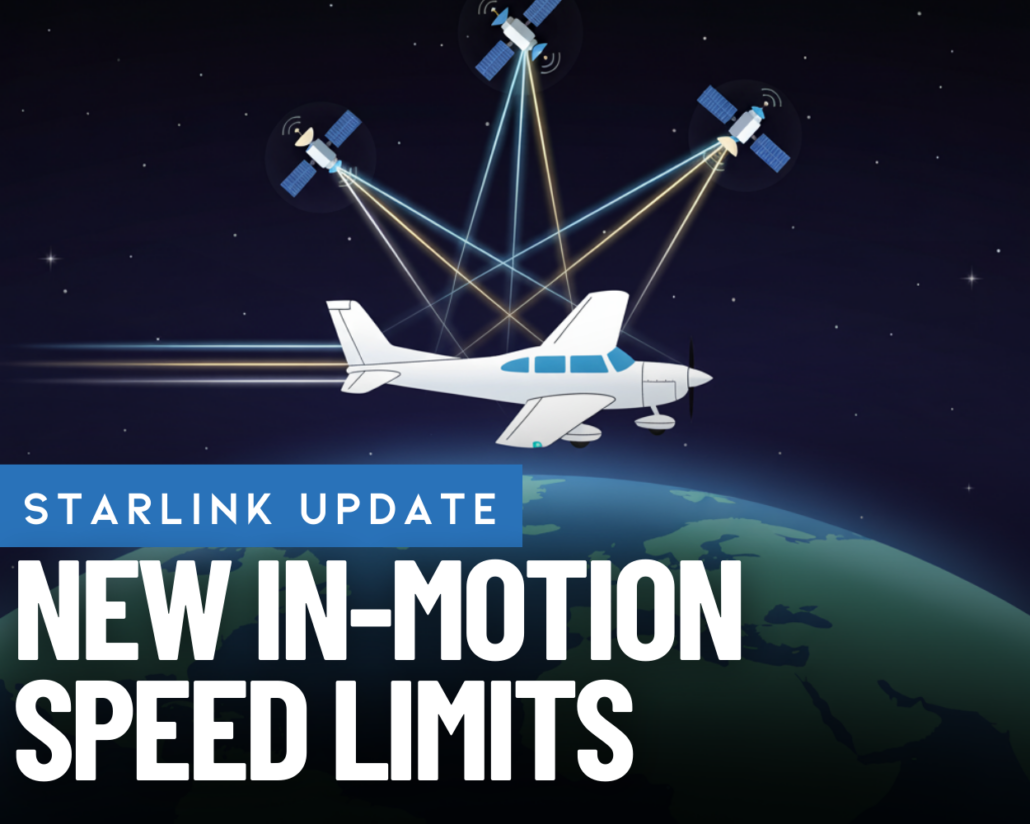
Roam and Priority plans now have a maximum supported in-motion speed of 100 mph (87 knots).
Earlier this year, Starlink overhauled its General Aviation plans, increasing included data, lowering pricing on its entry-level aviation plan, and introducing a 100 mph speed limit for its non-aviation plans. Here’s what those changes mean for pilots.
Starlink says that Roam and Priority plans now have a maximum supported in-motion speed of 100 mph (87 knots), effective March 3, 2026. Starlink also notes that they’ve detected some customers operating at higher speeds, and they’re pointing those customers to Aviation plan options designed for higher-speed use. So in summary:
- 100 mph (87 knots) maximum supported in-motion speed
- Applies to Roam and Priority plans
- Starlink describes these plans as intended for in-motion use on land or water (driving, boating)
Updated Aviation plan options (April 2026)
Starlink has updated its Aviation plans with more included data, simplified pricing, and new names that better reflect how aircraft operate:
General Aviation Local 50GB (formerly Aviation 300MPH)
- $200/month base subscription
- 50GB included each month (up from 20GB)
- In-motion supported up to 300 mph (260 knots)
- Additional data: 50GB for $25
- Coverage: Land, territorial waters, and within 12 nm
General Aviation Global 50GB (formerly Aviation 450MPH)
- $1,000/month base subscription
- 50GB included each month (up from 20GB)
- In-motion supported up to 450 mph (391 knots)
- Additional data: 50GB for $100
- Coverage: Land and ocean
Identity verification is still required for both plans, including a passport and aircraft details.
What changed
- 150% more included data (50GB vs. 20GB)
- Lower monthly cost for the 300 mph plan ($200 vs. $250)
- Simpler, block-based overage pricing
- Same performance, coverage, and speed limits as before
For existing customers, Starlink says the transition is automatic with no changes required to hardware or setup.
For most pilots, here’s what’s important:
- 100 mph (87 knots) is intentionally below the cruise speed of most GA airplanes. If you’re using Starlink in flight on a Roam or Priority plan, this change could matter immediately.
- Starlink is steering true in-flight users toward their General Aviation plans. If your goal is consistent connectivity in cruise, Starlink is basically saying, “pick a plan that matches your typical speeds and coverage needs.”
At the end of the day, your best move comes down to how and where you use Starlink. If you’re mostly connecting on the ground or in slower in-motion situations, staying on Roam or Priority and keeping it under 100 mph is still the simplest, most cost-effective path.
If you want reliable connectivity during cruise flight for typical GA speeds, the General Aviation Local 50GB plan is now a much more compelling option than before. With 50GB included and lower monthly pricing, it’s better aligned with real-world pilot usage—especially for weather, messaging, and light browsing.
And if you’re consistently operating at higher cruise speeds or flying over water, the General Aviation Global 50GB plan offers the same performance as before, but with significantly more included data and more predictable overage pricing.
One small note: you may see unfamiliar names like “Local Priority High-Velocity Terminal Access Charge” on your invoice. That’s just Starlink’s billing language for the same General Aviation plans.
Explore the General Aviation plans here.


This is a real shame! 90% of all GA planes operates between 100 and 160 kts and this no more than twice a month. $250 is five times the price for 1/5 of the capacity we had earlier. This is not a simple correction but a change of absurd dimensions and clearly a rip off for thousands of low budget GA pilots who invested in a Starlink Mini. Why not a third plan for speeds below 160kts at an normal price? Hello AOPA are you still alive???
This is a total ripoff! I never would have bought the Starlink Mini if I would have known I would be subjected to a 500% increase in price or $2,400 per year only five months later! I have tried to communicate with Starlink, but all they have is a Chat. The chat does not see the problem. Elon Musk would never accept a 500% increase from a supplier or as a customer. I have asked AOPA, NBAA and ABS to get involved.
This smacks of greed, strong statement out of the box but really, what else could it be? I fly twice a month in a weather and information infrastructure compromised area of the World. Starlink made my operation so much easier and safer yet now, l’m going back to scratchy GSM networks because the $250 is ludicrous. The guy next to me does animal anti-poaching for a charity, he relied massively on his Starlink – alas, no longer. Seems to me this was not thought out very well, it’s a blanket patch in a space where one size does not fit all.
Keep in mind also that cruise speed is being mentioned in the article, though speed over the ground is what Starlink cares about. I was going to get a mini so my family can have connectivity over long cross countries, but I will no longer consider that. Another option not mentioned was instead of typically looking for good tailwinds, one can look for absurd headwinds in order to avoid the absurd price plans!
My Starlink service will stay paused until they sort this out.
Good news is that pausing is free (for now!)
Easy way to fix this, everyone and I mean everyone shuts them off and quit funding them. They will have to get real or out of business. The customer actually has the final say, just have to use the power
Really?!? He’s is quite literally the richest man on Earth. Whatever happens, they will NOT go out of business, I assure you.
Starlink minis have become a weapon guidance system overseas ( Ukraine, Russia and soon to be more ) so profits will surely go up despite GA’s objections. But we’ll see. I hope we get some positive movement in our direction but definitely sn obscene increase in price and decrease in capabilities.
I just put mine on pause
Sorry, but how is the expense borne by Starlink greater if the customer is moving faster? Is there a technical reason or are the rates just a shakedown for the presumably richer customers?
I’m one of the thousands that told SpaceX to pound sand, and immediately canceled my service plan. But for those on Pause, I’d carefully check the small print. It’s my understanding that a Pause still incurs a $5 monthly fee. In other words, as the saying goes, there are still “no free lunches” in today’s world.
Received a Starlink Mini as a Christmas present from my wife. Bought a cover and the correct cable for my 414. Got to use it once. Immediately paused my account when this came out. If nothing changes pretty quick, I will cancel and put this thing on ebay, or I may just take it out back use it for target practice just to make me feel better. Look for that on youtube!
My Aircraft’s Maximum Structural Airspeed is 160 MPH… NOT Knots… Miles per hour. Vne= 165. I cruise at a far lower airspeed. Jan Moons is correct. Most of my flying is pleasure, and only occasionally instructing in this “EVERYONE IS BROKE” Trump War Economy. I was talking to my A&P, IA about the acceptable mounting for the Starlink. However with this development at this time, I was saved by my careful step by step approach and have not yet purchased a Starlink Mini. If the price does not go back down to $50.00 a month, then I will make a big saving and based on my typical flight in the Southwestern U.S.A., I will seldom fly in conditions where a Starlink is a real “Safety Necessity.” In other words, if the weather is ANYTHING like marginal, I will take a swim in my pool or light a nice fire in a fire pit and enjoy the incremental safety and savings.
So, they’re testing the market. When demand drops substantially because of high pricing, they’ll lower prices until they get the subscribers they want. Vote with your $.
My thoughts are the same as most of the other folks who have replied. The price point is all wrong. No thought or engagement was made to the GA community and the results are telling. Many, and I suspect most of GA have cancelled or suspended their subscriptions until Starlink realizes that there are other dedicated aviation services available at a much lower price point. If they want to play in this market environemnt they need to cut their pricing in half and guarantee no more “bait and switch”